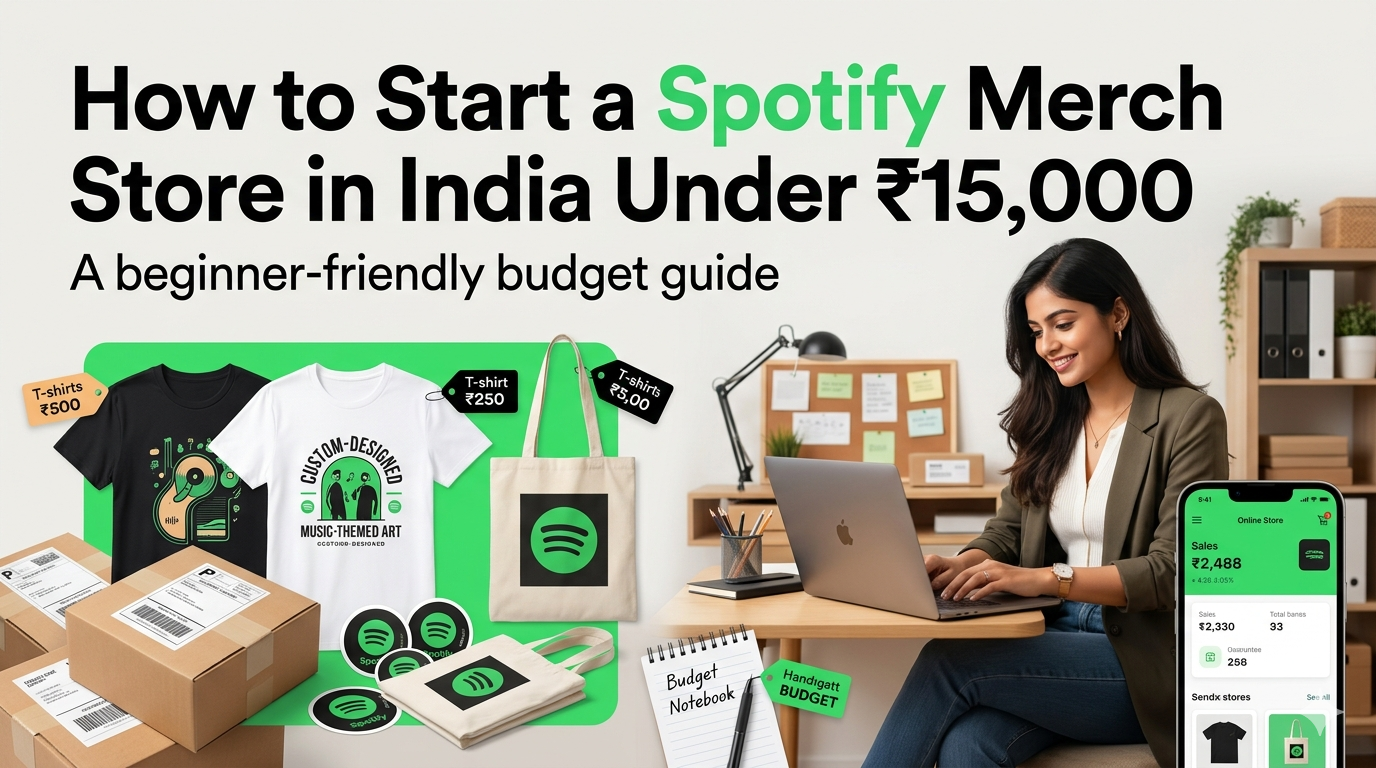
How to Start a Spotify Merch Store in India Under ₹15,000
Your fans are listening to your music every single day. They are streaming your songs on the way to work, playing your tracks on repeat while they study, and adding your albums to their favourite playlists. They love what you create. And many of them — more than you probably realise — would happily buy a t-shirt, a hoodie, or even a poster just to feel a little closer to the music they love.
That is what a Spotify merch store is all about. And the best part? Setting one up in India does not require a huge investment, a warehouse full of stock, or a business degree. With the right approach, you can have a fully working merch store — connected directly to your Spotify profile — for under ₹15,000. Sometimes far less.
This guide will walk you through everything from scratch, in simple and clear language, so that by the time you finish reading, you will know exactly what to do and how to do it.
What Is a Spotify Merch Store, and Why Does It Matter?
Before getting into the how, it helps to understand the what and why.
A Spotify merch store is simply an online shop that appears directly on your Spotify artist profile. When your fans visit your profile on Spotify, they can see your merch items — things like t-shirts, hoodies, caps, mugs, posters, or anything else you choose to sell. They can click on any item, and it takes them directly to your store where they can purchase it.
This is not a third-party marketplace where your products get buried among thousands of other sellers. This is your store, on your profile, seen by people who are already your fans. They are not random visitors — they are people who chose to listen to your music. That makes them the warmest possible audience for buying merch.
For an Indian artist, this opens up something genuinely exciting. India's music scene has grown massively over the last few years. Independent artists are building real fanbases without major label deals. Listeners on Spotify in India are increasingly passionate, loyal, and willing to support artists they love. And until now, most of those artists have had no easy way to turn that passion into a revenue stream outside of streaming royalties.
A Spotify merch store changes that.
It is also worth mentioning that for many artists, merch becomes a significantly larger income stream than streaming royalties. The numbers on Spotify per stream are well known to be small. But a single ₹800 t-shirt sale can equal months of streams in terms of money earned. Building a merch store is not just a nice extra — for growing artists, it can become one of the most important parts of their business.
The Technology Behind the Store — Understanding the Setup
You might be wondering — how exactly does a merch store appear on Spotify? Is it something Spotify handles on their own?
The answer is that Spotify does not run a merch platform directly. Instead, they have partnered with Shopify — one of the world's most trusted e-commerce platforms — to make merch selling possible. Here is how the system works.
You create an online store on Shopify. Shopify is the platform that actually hosts your products, handles payments, manages orders, and deals with the shopping experience. Then you connect that Shopify store to your Spotify for Artists account. Once connected, your products appear right on your Spotify profile.
So the setup has two key parts: your Shopify store and your Spotify for Artists account. Both need to be set up and linked together. Once that connection is made, managing everything — adding new products, checking orders, updating prices — happens through Shopify. Spotify just displays it.
Spotify also integrates with Printful, a print-on-demand service. This is what makes it possible to start selling without buying any stock upfront. More on that shortly.
Understanding Print on Demand — The Game Changer for Indian Artists
If you have never heard of print on demand, this concept alone might change how you think about selling merch.
Traditionally, selling merchandise meant buying stock in advance. You would design a t-shirt, order 50 of them from a printer, pay for all of them upfront, store them somewhere, and then hope you sold enough to cover your costs. If you overestimated demand, you were left with boxes of unsold t-shirts and a much lighter bank account.
Print on demand completely flips this model.
With print on demand, a product is only made when someone actually orders it. A fan visits your store, places an order, and pays. Only then does the print-on-demand company print your design onto the t-shirt, pack it, and ship it directly to your fan. You never touch the product. You never hold any inventory. You never risk being stuck with unsold stock.
This model is perfect for independent artists — especially in India where upfront investment is a genuine concern. You can start with zero products in your hands, list as many items as you like, and only pay the base production cost when a sale is made. Everything above that base cost is your profit.
For someone working within a ₹15,000 budget, print on demand is not just convenient — it is essential. It is what makes starting without a big investment actually possible.
Breaking Down the Budget — Where Your ₹15,000 Goes
Let us talk real numbers so there are no surprises along the way.
Starting a Spotify merch store in India under ₹15,000 is absolutely achievable, and most people can do it for significantly less. Here is where the money actually goes.
Shopify Subscription
Shopify has a starter plan that is specifically great for artists who just want to sell on Spotify without needing a full e-commerce website. This plan costs around $5 per month — which translates to roughly ₹415 per month at current rates. For a full year, that is approximately ₹5,000. However, Spotify musicians get an exclusive 90-day free trial on Shopify's basic plan, which gives you three months to test everything before spending a rupee.
Domain Name (Optional but Recommended)
If you want a custom web address for your store — something like yourartistname.com — a domain typically costs between ₹800 and ₹1,500 per year depending on the registrar you use. This is optional when starting out, but it adds credibility to your brand.
Logo and Branding Design
If you already have a logo and brand identity, this cost is zero. If you need to create one, there are free tools available, or you can hire a designer. Basic branding work in India from a freelancer typically ranges from ₹1,500 to ₹5,000 depending on complexity. Getting this right matters — your merch store is a reflection of your artistic brand, and a well-designed logo makes everything look professional. (More on this in a moment.)
Initial Product Designs
Your merch lives or dies by its designs. At minimum, you need one or two strong designs to start. These can be created digitally using free tools if you have design skills, or outsourced to a designer. Budget approximately ₹1,000 to ₹3,000 for initial design work if outsourcing.
GST Registration (If Selling Commercially)
If you plan to run this as a real business in India, GST registration may be required once your sales exceed the threshold. The registration itself is free through the GST portal, though some people hire a professional to assist, which typically costs ₹500 to ₹1,500.
Sample Orders
This is highly recommended. Before your store goes live, ordering a sample of your own products — so you can see the quality, feel the fabric, and verify that your designs look as expected — is a smart investment. A sample t-shirt through Printful typically costs around ₹1,500 to ₹2,500 including shipping to India.
Adding these up, a realistic startup budget looks like this — roughly ₹5,000 for Shopify over the first year, ₹1,000 for a domain, ₹2,000 for design work, and ₹2,000 for a sample order. That is ₹10,000 — comfortably under the ₹15,000 ceiling with room to spare for any unexpected costs.
Step-by-Step: Setting Up Your Spotify Merch Store
Now let us walk through the actual process of getting everything set up. Take this one step at a time and it is much less overwhelming than it might initially seem.
Step 1 — Make Sure You Have Spotify for Artists Access
Everything starts here. Spotify for Artists is the dashboard that gives you control over your artist profile — including the merch section. If you are a musician on Spotify, you need to claim your artist profile through Spotify for Artists.
Go to artists.spotify.com and log in with your Spotify account. If you have not claimed your profile yet, you will need to go through a verification process. This typically takes a few days and requires you to prove you are the actual artist behind the profile. Once verified, you will have full access to your artist dashboard.
Step 2 — Create Your Shopify Store
Go to shopify.com and sign up for an account. As a Spotify musician, you are eligible for an exclusive extended free trial — make sure to access this through the Spotify for Artists merch section to get the best deal.
During setup, you will choose a store name, set up your payment information, and configure basic settings. You do not need to launch a full public website — your Shopify store can function quietly in the background, with Spotify as the primary storefront where fans discover and click through to purchase.
Take time during this step to set up your store properly. Choose a theme that matches your artist aesthetic. Write a compelling "About" section. Make sure your store looks like it belongs to the same artist that fans are hearing on Spotify. Consistency between your Spotify profile and your store builds trust and makes fans more comfortable buying.
This is also the stage where many artists realise they could benefit from professional help. A properly designed Shopify store — with the right theme, clear navigation, compelling product pages, and a seamless checkout experience — converts significantly better than a hastily thrown-together one. If you are not confident setting this up yourself, reaching out to a web developer who specialises in Shopify stores can make a meaningful difference to your sales from day one.
Step 3 — Connect Printful to Your Shopify Store
Log in to Printful (printful.com) and create a free account. Then connect Printful to your Shopify store through the Shopify app store — Printful has an official Shopify integration that makes this a straightforward process.
Once connected, Printful becomes your production partner. Every time a fan orders something from your store, Printful automatically receives the order, produces the item, and ships it. The whole process is automated — you do not need to do anything manually for each order.
Step 4 — Create Your Products
This is the fun part. Inside Printful, browse their product catalogue and choose what you want to sell. T-shirts are the most popular merch category for artists, but hoodies, caps, tote bags, phone cases, posters, and even socks are all options worth considering.
For each product, you will upload your design. Printful has a visual mockup generator that shows you exactly how your design will look on the product before you commit to anything. This is incredibly useful — you can see realistic previews of every item in your store without ordering a single sample.
Set your prices carefully. You need to cover Printful's base production cost, Shopify's transaction-related fees, and still leave yourself a healthy profit margin. Research what other artists charge for similar items and price accordingly. Most artist t-shirts sell in the ₹700 to ₹1,500 range in India.
Step 5 — Connect Shopify to Spotify for Artists
Now bring it all together. Log into your Spotify for Artists dashboard, go to the Profile section, and find the Merch tab. You will see an option to connect your Shopify store.
Enter your Shopify store address and follow the connection prompts. Once linked, your Shopify products will appear in the Spotify merch management section. You can then choose which products to publish — these are the items that will actually appear on your Spotify profile.
You can publish up to 250 items, pin up to two items to the top of your merch tab, and even feature a specific item as your "Artist Pick" on your music tab. Take advantage of these features — items that are pinned and prominently featured get significantly more attention than items buried in the list.
Step 6 — Tag Your Merch to Your Releases
This is a powerful feature that many artists overlook. Spotify allows you to tag specific merch items to specific music releases.
When you tag a hoodie to your latest single, that hoodie will appear on the album page for that single and in the Now Playing view whenever someone listens to that song. Imagine a fan streaming your track, feeling connected to the music, and right there on screen they see a hoodie with your artwork. That is an impulse purchase waiting to happen.
Tag your merch thoughtfully. Match the aesthetic of each product to the release it represents. A dark, moody hoodie belongs tagged to a dark, moody album. A bright, playful tote bag belongs with an upbeat summer single.
Step 7 — Set Up Payments for India
This step requires extra attention for Indian artists. Shopify supports Payoneer, Razorpay, and PayPal as payment processors in India, among others. Razorpay is one of the most commonly used options for Indian sellers because it supports UPI, credit cards, debit cards, and net banking — covering the full range of how Indian customers prefer to pay.
Set up your preferred payment processor, verify your bank account details, and test a small transaction to make sure everything flows correctly before going live.
Making Your Merch Actually Sell
Setting up the store is only half the job. The other half — the part that many artists do not think enough about — is making the merch genuinely appealing so that fans actually buy it.
Design is everything. A mediocre design on a good product will not sell. A great design on a basic t-shirt will. Invest in quality design work that captures your artistic identity. Your merch should feel like an extension of your music — not just a t-shirt with your name printed on it.
Think about what your music represents visually. What colours, moods, imagery, and themes define your sound? Your merch designs should tell the same story your music does, just in a different medium. Fans who wear your merch are wearing a piece of your art — that is what makes it meaningful, and meaningful things sell.
Photography matters enormously. Your product photos are what fans see before they decide to buy. Printful's mockup generator is convenient, but nothing converts better than real lifestyle photos — images of actual people wearing or using your merch in real environments. A photo of your t-shirt on a hanger pales in comparison to a photo of a real fan wearing it at a concert.
If budget is tight, even photographing the sample order you received on yourself or on a friend makes a massive difference. Good photos are the single highest-return investment you can make in your store's performance.
Write product descriptions that connect emotionally. Do not just write "black t-shirt, 100% cotton, unisex fit." Tell a story. What inspired this design? What does it mean? Why did you create it? Fans do not just want a product — they want a connection. A product description that says "This design was inspired by the nights I spent writing the songs on this album — it represents that feeling of being awake when the world is asleep" gives the product meaning. Meaning sells.
Create scarcity when it makes sense. Limited edition drops — "only available for 48 hours" or "limited to 100 pieces" — create genuine urgency. Artists who treat merch drops like events, announcing them on social media and building anticipation, consistently outsell those who simply list products and wait.
Promoting Your Merch Store to Your Indian Audience
Having a beautiful store connected to your Spotify profile is great. But fans will not find it unless you actively point them to it.
Your Spotify bio is prime real estate. Many artists do not write compelling bios. Yours should include a clear, warm mention that you have merch available for fans who want to show their support. Keep it natural — not salesy. Something as simple as "You can find my music, tour dates, and merch right here on my Spotify profile" works.
Instagram and YouTube are your biggest drivers. Wear your own merch in your content. Stories, reels, photos — every time you appear wearing your t-shirt or hoodie, it is a natural and effortless promotion. Fans notice. When followers see you genuinely using your own products, it builds desire in a way no advertisement can replicate.
Behind-the-scenes content converts well. Show the process — the design ideation, the sample that arrived, the moment you first held the finished product. Indian audiences particularly respond to authentic, personal content. Letting fans into your creative process, including the merch creation process, builds a sense of shared ownership that makes them far more likely to buy.
Launch announcements should feel like events. Do not just post "My merch store is live." Build up to it over a few days. Share a teaser of the design. Countdown to the launch. Go live on Instagram to show the products. Make it a moment. First launch energy is irreplaceable — and you only get one first launch.
Common Mistakes to Avoid
Most new merch stores in India make the same handful of mistakes. Knowing them in advance puts you ahead of almost everyone else.
Listing too many products too soon. Starting with three or four exceptional products is far more effective than launching with thirty mediocre ones. Quality and curation beat quantity at every stage.
Ignoring pricing psychology. Indian consumers are value-conscious. Pricing your merch too high from the start, without an established fanbase that trusts your brand, is a common reason stores fail to get initial traction. Start with accessible price points and increase them as your brand grows.
Skipping the sample order. Never sell a product you have not seen and felt yourself. Quality control matters. Discovering that the print quality is disappointing after fans have already ordered is a reputation problem that is difficult to recover from.
Not promoting across multiple touchpoints. Relying only on your Spotify profile to drive sales is not enough, especially in the early stages. Your social media, your YouTube, your WhatsApp community — every channel should know your store exists.
Setting up the store once and never updating it. Your merch store should evolve with your music. New releases deserve new merch. Seasonal designs stay relevant. Removing older items keeps the store feeling fresh and curated. An artist who regularly updates their merch store signals to fans that they are active and engaged.
What Makes a Merch Store Successful Long-Term
The artists who build genuinely successful merch businesses — ones that earn meaningful income month after month — all share certain habits.
They treat merch as part of their creative identity, not as an afterthought. Every product they release is thought through with the same care as a song. The design, the presentation, the timing, the storytelling — all of it is intentional.
They build their store properly from the beginning. The technical foundation — a well-designed Shopify store, properly connected to Spotify, with high-quality product pages and smooth checkout — is something they invest in correctly rather than rushing. A store that looks professional and works smoothly earns trust. A store that feels thrown together loses it.
They stay consistent. The artists whose merch stores generate steady income are the ones who regularly launch new items, promote them actively, and treat their store as a living part of their business rather than something they set up once and forgot about.
And they take help when they need it. Building a successful online store involves design, e-commerce strategy, user experience, payment setup, and ongoing management. Many successful artists work with professionals who handle the technical and design side so they can focus on what they do best — making music. Having the right support structure from the beginning can mean the difference between a store that slowly fades into irrelevance and one that becomes a real, growing revenue stream.
Is ₹15,000 Really Enough?
Yes — and here is the honest truth about that number.
₹15,000 is more than enough to launch a properly set up, professionally presented Spotify merch store in India. Many artists have done it for less than ₹8,000.
But what ₹15,000 will not do is guarantee success. That depends on your designs, your promotional effort, your fanbase engagement, and the quality of your store setup.
Where the investment really pays off is in getting the foundational elements right — a store that looks credible, functions smoothly, and represents your brand with quality. That is what converts fans into buyers. Cutting corners on the setup to save ₹2,000 often costs far more in lost sales over time.
The best approach is to budget realistically, invest in the things that directly impact quality and perception, and launch with intention rather than rushing.
Taking the First Step
If you have been thinking about this for a while but have not started yet, the honest reality is that the biggest barrier is not budget, not technical knowledge, and not product availability. The biggest barrier is simply getting started.
Every week you do not have a merch store is a week your fans are streaming your music with no way to support you beyond a fraction-of-a-paisa stream royalty. Every new fan who discovers your music and loves it — that is a potential customer who has nowhere to spend their support.
Your store does not need to be perfect to launch. It needs to be good enough to be proud of — and you can improve it as you go. The artists who succeed are not the ones who wait until everything is perfect. They are the ones who start, learn, and keep improving.
You have the music. You have the fans. You have a platform in Spotify that is putting your work in front of millions of listeners. All that is missing is the store.
Need a Professional Project?
We specialize in MERN Stack, Telegram Bots, and SEO-optimized web solutions. Let's build something amazing together!