MERN vs MEAN Stack: Which Is Better for Your Business Project?
Both of them are popular. Both are widely used by developers around the world. And both are built on JavaScript — which means they share a lot in common. But they are not the same, and the difference between them can seriously affect how your project gets built, how fast it launches, and how well it scales as your business grows.
This guide will walk you through everything you need to know — in plain, simple language — so you can make the right decision for your business without needing a computer science degree to understand it.
What Is a Technology Stack?
Before comparing MERN and MEAN, let us understand what a "stack" actually means.
When developers build a web application, they do not use just one tool. They use a combination of technologies — one for the database (where data is stored), one for the server (which handles the logic), and one for the front end (what users actually see). This combination of technologies working together is called a technology stack.
Think of it like building a house. You need a foundation, walls, and a roof. Each part is different, but they all work together to create something complete. A technology stack works the same way — different technologies, each doing their part, creating a full working application.
Both MERN and MEAN are what developers call full-stack JavaScript frameworks, which simply means every part of the application — from the database to the interface — is built using JavaScript. This is one of their biggest advantages, and it is why both stacks have become so popular in recent years.
Let us decode what each letter stands for, because that is where the real difference lives.
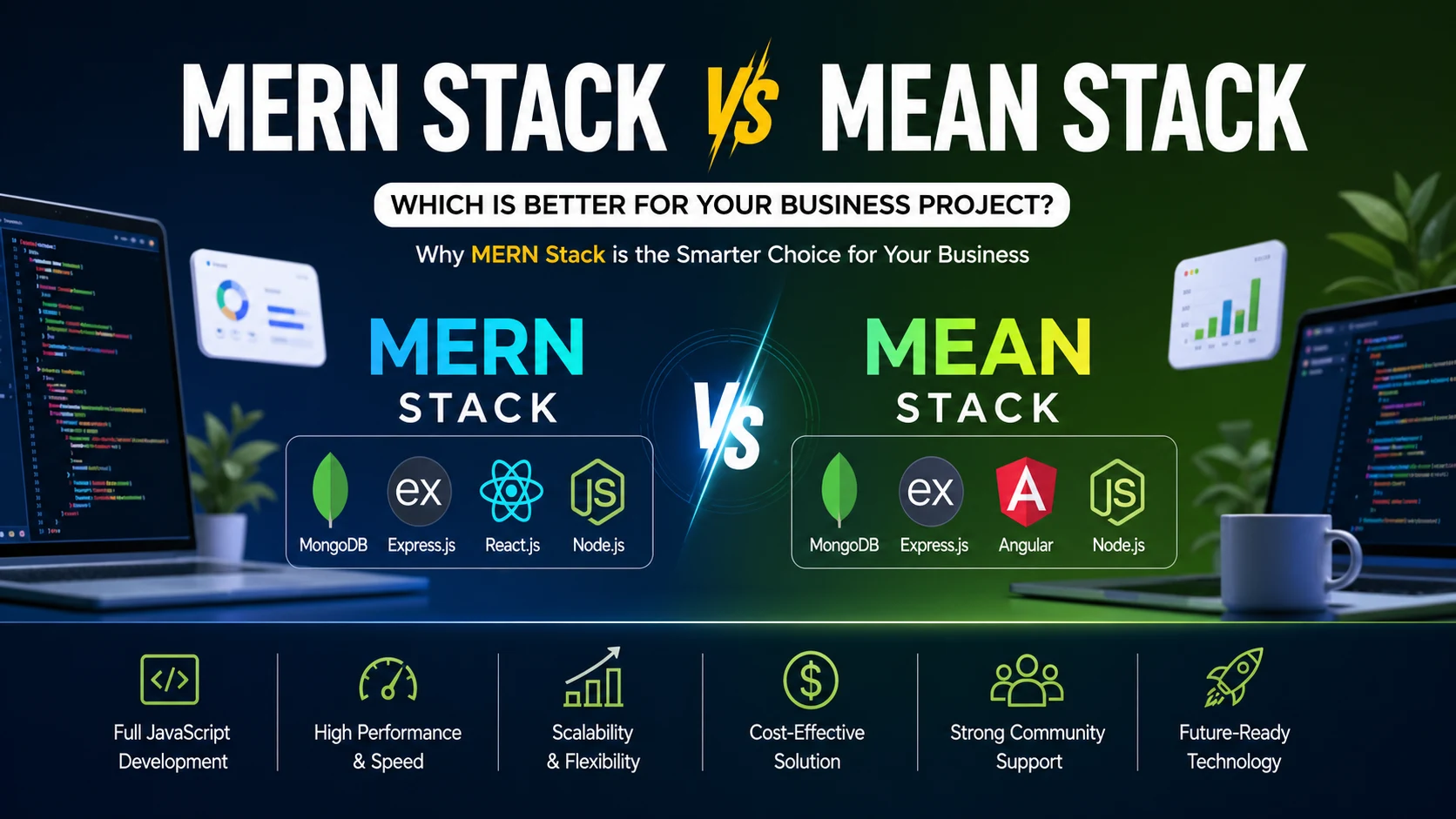
MEAN Stack
- M — MongoDB (database)
- E — Express.js (server-side framework)
- A — Angular (front-end framework)
- N — Node.js (runtime environment)
MERN Stack
- M — MongoDB (database)
- E — Express.js (server-side framework)
- R — React (front-end library)
- N — Node.js (runtime environment)
If you look closely, you will notice that three out of four components are exactly the same. MongoDB, Express.js, and Node.js appear in both stacks. The only difference is the front-end technology — Angular in MEAN versus React in MERN.
So at its core, the MERN vs MEAN debate is really a question: Angular or React? Everything else is the same. But that one difference has a massive impact on how your project gets built, how your team works, and what your application looks like in the end.
Understanding the Shared Technologies
Since MongoDB, Express.js, and Node.js are shared by both stacks, it is worth quickly understanding what each one does — because they form the backbone of both MERN and MEAN.
MongoDB — The Database
MongoDB is where your application stores all its data. Unlike traditional databases that organize data into rows and columns like a spreadsheet, MongoDB stores data in a format that feels more like documents or folders. This makes it incredibly flexible.
For a business, this means you can store complex information — like a user profile with addresses, purchase history, and preferences — all in one place, without needing complicated database structures. MongoDB handles large amounts of data well and grows smoothly as your user base expands.
Express.js — The Server Framework
Express.js sits between your database and your front end. It handles the logic — deciding what data to fetch, what rules to apply, and how to respond to requests from the user's browser. It is lightweight, fast, and gives developers a clean way to build the behind-the-scenes logic of an application.
Node.js — The Engine
Node.js is what allows JavaScript to run on the server — not just in the browser. Before Node.js, JavaScript could only be used to make web pages interactive. Node.js changed that completely, making it possible to build the entire application — front end and back end — in one language.
For businesses, this is a significant advantage. Your development team does not need to switch between different programming languages. Everyone speaks JavaScript, which speeds up development and makes collaboration easier.
Angular: The MEAN Stack's Front End
Angular is the front-end framework used in the MEAN stack. It was created by Google and has been around for a long time, making it one of the most battle-tested tools in web development.
Angular is what developers call an opinionated framework. This means it comes with a very specific way of doing things. There is a defined structure, a set of rules, and a clear architecture that every Angular project follows. For developers, this can feel restrictive at first, but for businesses, it has some very real advantages.
Because Angular has a strict structure, different developers working on the same project will always follow the same patterns. The code stays organized and consistent. For large teams or long-term projects, this makes a huge difference in how maintainable the application becomes over time.
Angular also comes with a huge number of built-in features — things like form handling, routing (how users navigate between pages), and data management are all included out of the box. Developers do not need to find and add third-party tools for common tasks; Angular already has them.
The trade-off is that Angular has a steeper learning curve. It is more complex to learn, and its projects tend to be larger in terms of file size, which can affect how fast your application loads for users.
React: The MERN Stack's Front End
React is the front-end library used in the MERN stack. It was created by Facebook (now Meta) and has grown to become the most widely used front-end technology in the world.
Unlike Angular, React is not opinionated. It does not tell you how to structure your project or what tools to use alongside it. React's job is specifically focused on building the user interface — what people see and interact with on screen. For everything else, developers choose their own tools and organize things how they prefer.
This flexibility is React's biggest strength. Developers can build exactly what they need, in the way that makes most sense for their project. It also means React has an enormous ecosystem — thousands of add-on libraries and tools that can be plugged in to handle almost any requirement.
React uses a concept called components, which are like small, reusable building blocks. A button, a card, a navigation menu — each of these can be built as a component once and reused across the entire application. This makes development faster and keeps the codebase clean.
React is also easier to learn than Angular, which means there is a larger pool of developers who know it — and hiring React developers is generally easier and sometimes less expensive than finding experienced Angular developers.
Key Differences at a Glance
Now that you understand each piece, here is how the two stacks compare across the dimensions that matter most for a business decision.
Learning Curve
Angular comes with a steeper learning curve because of its structured, complex architecture. React is considered easier to pick up, especially for developers already familiar with JavaScript.
Flexibility
React gives developers more freedom to choose how they structure things. Angular is more rigid, following a specific pattern for everything.
Performance
Both stacks perform well. React has a slight edge in applications with very dynamic, frequently changing interfaces because of how it updates the screen — it only changes what needs to change, rather than refreshing everything. Angular has improved significantly in this area over time, but React still leads slightly in raw UI performance for complex apps.
Built-in Features
Angular wins here. It comes loaded with built-in solutions for common development needs. React requires developers to bring in additional tools for things like state management, routing, and form validation.
Community and Popularity
React currently has the larger community and wider adoption globally. More developers know it, more resources exist for it, and more companies use it. Angular has a strong community too, particularly in enterprise environments.
Project Size and Scalability
Angular is well-suited for large, complex enterprise applications where consistency and structure are critical. React scales beautifully too, but its flexibility means discipline is needed to keep large projects organized.
Hiring Developers
React developers are more commonly available in the job market. If you are building a team or hiring freelancers, you will generally find more React talent at competitive rates.
When MEAN Stack Makes More Sense for Your Business
MEAN stack, with Angular at its front end, is a strong choice in specific business situations. Let us walk through the scenarios where MEAN genuinely shines.
Large Enterprise Applications
If you are building a complex business application — think ERP systems, admin dashboards with dozens of modules, internal tools used by large teams — Angular's structured approach becomes a major asset. The enforced patterns mean that even as the project grows and new developers join, the codebase stays consistent and manageable.
Teams That Prefer Structure
Some development teams, especially those coming from a background with more structured languages, find Angular's approach comfortable and productive. If your team already has Angular experience, there is no reason to switch.
Applications With Complex Forms and Data Flow
Angular has powerful built-in tools for handling forms — especially forms with complex validation rules, conditional fields, and real-time feedback. For business applications like insurance platforms, banking portals, or CRM systems where forms are central to the experience, Angular's form handling is genuinely excellent.
Long-term Maintenance Priority
Because Angular enforces a standard structure, long-term maintenance becomes more predictable. Five years after launch, a new developer joining the project can orient themselves quickly because everything follows the same patterns.
When MERN Stack Makes More Sense for Your Business
MERN stack, with React at its front end, is currently the more popular choice — and for many business scenarios, it is the smarter one. Here is when MERN is the right pick.
Startups and Fast-Moving Projects
If speed to market matters — and for most startups and growing businesses, it absolutely does — React's flexibility and large developer community make MERN the faster choice. You can find developers quickly, get up and running faster, and iterate rapidly based on user feedback.
User-Facing Applications With Rich Interfaces
React was built for creating highly interactive, visually engaging user interfaces. If your application needs to feel smooth, fast, and modern — think dashboards, marketplaces, fintech apps, social platforms — React's approach to building interfaces makes this easier to achieve.
E-commerce and Customer-Facing Platforms
The online shopping world has largely adopted React. Its component-based structure makes building product listings, shopping carts, checkout flows, and personalized experiences clean and efficient. For any business-to-consumer product, MERN is a natural fit.
When You Need a Large Talent Pool
React developers are significantly more available than Angular developers. For a business trying to hire or work with freelancers, this translates to more options and often better rates. The barrier to finding skilled help is simply lower with MERN.
Applications That May Evolve Significantly
Because React is flexible, it is easier to adapt your application as your business needs change. You are not locked into a rigid structure, which makes pivoting and adding new features more straightforward.
The Developer Perspective — What Your Team Will Experience
If you are a business owner or decision-maker who is not a developer yourself, it is still worth understanding what the day-to-day building experience looks like with each stack — because it directly affects your project timeline and budget.
With MEAN and Angular, your developers will spend more time upfront setting up the architecture correctly. Angular projects have more files and more structure from the start. This can feel slow at the beginning, but it pays off in larger projects where consistency becomes critical. Developers who know Angular well tend to be very productive within its structure.
With MERN and React, your developers will move faster in the beginning. Setting up a React project and getting visible results is quicker. The challenge comes as the project grows — without Angular's enforced structure, React projects require disciplined developers who know how to keep large codebases organized. A well-run React project is fast and elegant. A poorly managed one can become messy.
For most business owners, this means one practical question: what does my development team know? If your team has Angular experience, MEAN will be more productive. If they know React — or if you are hiring fresh — MERN is likely the better bet.
Cost Considerations for Your Business
Budget is always a real factor in business decisions. Here is how the two stacks compare from a cost perspective.
Development Cost
React developers are more widely available, which generally means more competition and better pricing options. Angular developers, particularly senior ones, can command higher rates because the skill is less common. For businesses working with tight budgets or hiring in competitive markets, MERN often comes out cheaper.
Time to Launch
React's lower barrier to entry and faster initial setup often means MERN projects launch faster. Angular's setup overhead can add days or weeks to a project timeline. For a business, faster launch means earlier revenue — which makes MERN attractive from a financial standpoint.
Long-term Maintenance
This is where MEAN can recoup some costs. Angular's enforced structure can reduce the time spent on code reviews, refactoring, and debugging inconsistencies in large, long-running projects. If your application will be maintained by a team over many years, Angular's structure may lower total maintenance costs.
Hosting and Infrastructure
Both stacks have essentially identical hosting requirements and costs. Both run well on all major cloud platforms. This is not a differentiating factor.
Real-World Business Examples
Understanding which types of businesses and applications have found success with each stack can help clarify the decision.
MEAN Stack success stories tend to appear in enterprise software, internal business tools, financial services platforms, and applications built by companies with established development teams that have standardized on Angular. Many banks, insurance companies, and large enterprises use Angular because of its structure and the comfort it gives to compliance and IT governance teams.
MERN Stack success stories are everywhere in consumer technology. Social media platforms, fintech apps, e-commerce sites, content platforms, and SaaS products have broadly adopted React. The websites and apps that most people use daily — from streaming services to online marketplaces — are commonly built with React.
Myths and Misconceptions
There are a few things that people often get wrong about this comparison. Let us clear them up.
"Angular is dying." This is not true. Angular is actively maintained by Google, has a strong community, and is widely used in enterprise environments. It is simply less trendy than React right now, but trendy does not mean better for every situation.
"React is always faster." React has performance advantages in specific scenarios — particularly in applications with very dynamic interfaces. But a well-built Angular application can be just as fast for most business use cases.
"MERN is harder to scale." This is a misconception based on poorly built React projects. A properly structured MERN application scales extremely well, as proven by some of the world's largest platforms.
"You must choose one and stick with it forever." Technology decisions can be revisited. While migrating between stacks is not trivial, businesses evolve their technology over time. The more important thing is choosing what is right for where you are today.
Making the Final Decision
Here is a simple way to think about this decision for your specific business situation.
Choose MERN if:
- You are building a consumer-facing product with a rich, modern interface
- Speed to market is a high priority
- You are hiring developers or working with freelancers
- Your application will have frequent UI updates and a dynamic experience
- Your team already knows or prefers React
- You are building a fintech, e-commerce, SaaS, or content platform
Choose MEAN if:
- You are building a large enterprise application with many modules
- Your development team already works with Angular
- Strict code structure and consistency is a priority
- Your application has complex form handling as a core feature
- You are building for a large organization where multiple teams will work on the same codebase
- Long-term governance and compliance are important factors
There is genuinely no universally wrong answer here. Both stacks are proven, both are supported, and both can produce excellent business applications. The right choice depends on your specific goals, your team, and your timeline.
The Verdict
If you are building a modern, user-facing business application and you are starting fresh — MERN is likely the better choice for most businesses today. React's dominance in the front-end world, the availability of skilled developers, the speed of development, and its proven performance in exactly the kinds of applications most businesses are building gives it a practical edge.
That said, if your project is a large enterprise application, your team is already skilled in Angular, or your priority is a tightly governed, structured codebase for a complex system — MEAN is absolutely the right choice and should not be dismissed just because it is less trendy.
The most important thing is not which stack is objectively "better" — because neither is. The most important thing is which stack is better for your business, your team, and your project right now.
Make that decision clearly, commit to it, and then focus your energy on building something genuinely valuable for your users. The technology stack is just the foundation — what you build on top of it is what actually matters.
Need a Professional Project?
We specialize in MERN Stack, Telegram Bots, and SEO-optimized web solutions. Let's build something amazing together!